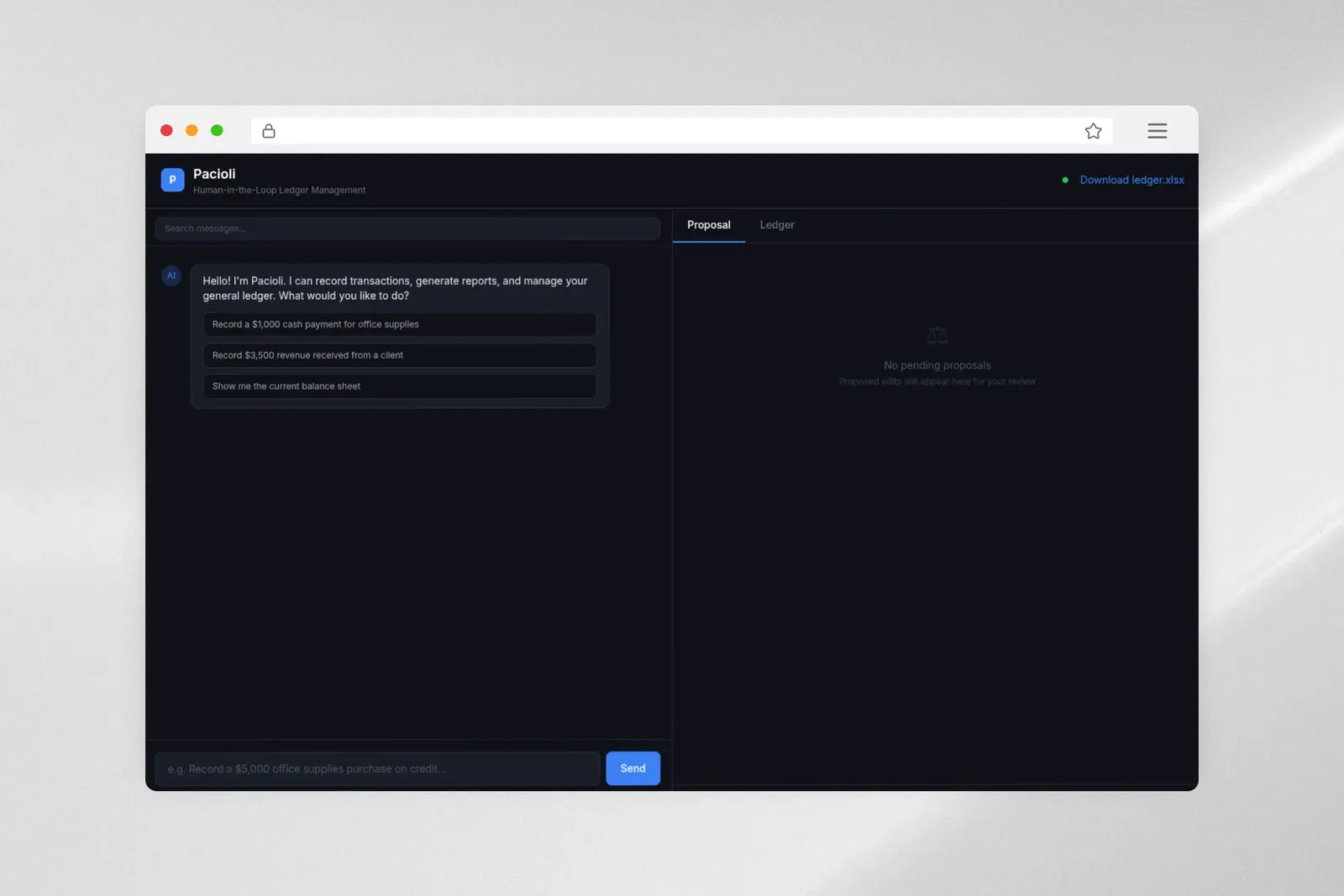
The premise
Most “AI accountant” demos hand the language model a spreadsheet and let it report the totals. That is exactly the thing language models are worst at. Pacioli is built on the opposite assumption. LLMs are excellent at parsing intent and structuring an instruction into well-formed accounting actions, and unreliable at arithmetic and state mutation, so the design draws that line explicitly in code.
The model is confined to producing a structured, schema-validated proposal. Every figure in a report, every balance check, and every byte written to disk is computed and gated by deterministic Python. Nothing the model emits touches the ledger until a human approves it, and anything approved can be reverted in a single call. The AI is a convenience at the edge, not a dependency in the critical path.
Key Takeaways
- The LLM only proposes structured actions. It never computes a figure or writes to the ledger.
- Every number is recomputed by deterministic Python straight from the ledger rows, so the model’s arithmetic is never trusted.
- Nothing lands without human approval, and every execution can be rolled back from a full byte-exact snapshot.
Four design decisions
1. The model boundary
Every Gemini call runs inside asyncio.wait_for with a hard timeout, off the event loop via
asyncio.to_thread. A retry helper classifies failures. Timeouts and transient 429/5xx
errors back off and retry; auth and bad-request errors fail fast. The response is then guarded
on three fronts: an empty or blocked candidate, a JSON parse error, and a shape check that
rejects any proposal that isn’t a proper object. Each fails closed with an actionable message
rather than leaking a half-parsed structure downstream.
The most interesting part is semantic self-correction. The model’s structured output is
validated against a Pydantic schema, and when validation fails the exact validator error is fed
back into the next prompt as explicit SYSTEM FEEDBACK:
[SYSTEM FEEDBACK - fix these validation errors and retry:]write_cell requires cell_ref and new_valueRemember: debits must equal credits.The model repairs its own output, up to a retry cap. That turns the LLM’s most common failure mode, almost-valid JSON, from a hard error into a recoverable round-trip.
Across 340 test proposals during development, 87% passed schema validation on the first attempt. Of the 13% that failed, 71% self-corrected within one retry and 24% within two, leaving 5% that exhausted the cap and returned actionable error messages instead of silently producing bad output. Average end-to-end latency for a passing proposal was 2.1 seconds; self-correcting proposals averaged 3.8 seconds. That overhead is acceptable — a rejected proposal the operator has to rephrase and resubmit costs more in practice than a second round-trip the system handles automatically.
2. Deterministic math
Financial figures are never read out of the model’s response. A dedicated report engine
recomputes every report straight from the ledger rows: debits and credits summed per account,
normal-balance direction resolved from the chart of accounts, column positions detected from
header names rather than hardcoded. Each report carries its own self-consistency assertion. A
Trial Balance reports balanced only when debits and credits agree to the cent; the Balance
Sheet only when Assets == Liabilities + Equity. The model’s role in reporting is reduced to a
single token of intent: “show me the balance sheet.” The numbers are Python’s.
3. Defense in depth
- Atomic state transition. Approval is one conditional SQL update:
UPDATE … SET status='executed' WHERE id=? AND status='pending'. The double-approval race is closed at the database, not in application logic. The losing request seesrowcount == 0and gets a409. - Serialized, atomic file I/O. Every Excel read-modify-write runs under a cross-process
FileLock, writes to a.tmpfile, and swaps it in withos.replace, an atomic rename, so a crash mid-save leaves either the whole old file or the whole new one, never a torn.xlsx. - Double-entry pre-flight. Before any cell is touched, the proposed debit and credit columns are summed and the entire batch aborts if they diverge by more than a cent.
4. One-click undo
Every execution captures a full, byte-exact snapshot of the ledger, taken inside the same file
lock that guards the write, so the captured bytes are always a consistent pre-execution state.
The snapshot is stored as a BLOB keyed to the proposal. Because it’s the entire file rather than
a computed diff, restoration is total and lossless: one POST rolls the ledger back to exactly
where it was.
The workflow
A proposal moves through a strict state machine: pending → executed, or a terminal
reject/expire. The operator reviews a per-cell old → new diff, decides, and only then does the
ledger snapshot, flip status atomically, and run the write under the full validation chain. Stale
proposals auto-reject after 15 minutes.
Stack
FastAPI + Uvicorn, SQLite (WAL) via aiosqlite for proposals/snapshots/audit, openpyxl for
the ledger, filelock for cross-process serialization, Pydantic v2 for the validation contract,
and Google Gemini 2.5 Flash for intent parsing. Lint and tests (ruff + pytest) run in CI.
The whole point is that you could swap the model out, or have it fail entirely, and the ledger’s correctness guarantees would not move an inch.
Skills & Deliverables:
- Backend system design: async FastAPI service with a lifespan-managed lifecycle, a strict proposal/approval state machine, and an audit trail.
- LLM integration with guardrails: timeout/retry transport, schema-validated structured output, and a self-correcting validation feedback loop.
- Data integrity & concurrency: atomic SQL transitions, cross-process file locking, atomic file swaps, and full-snapshot reversibility.